Free · Instant · No signup
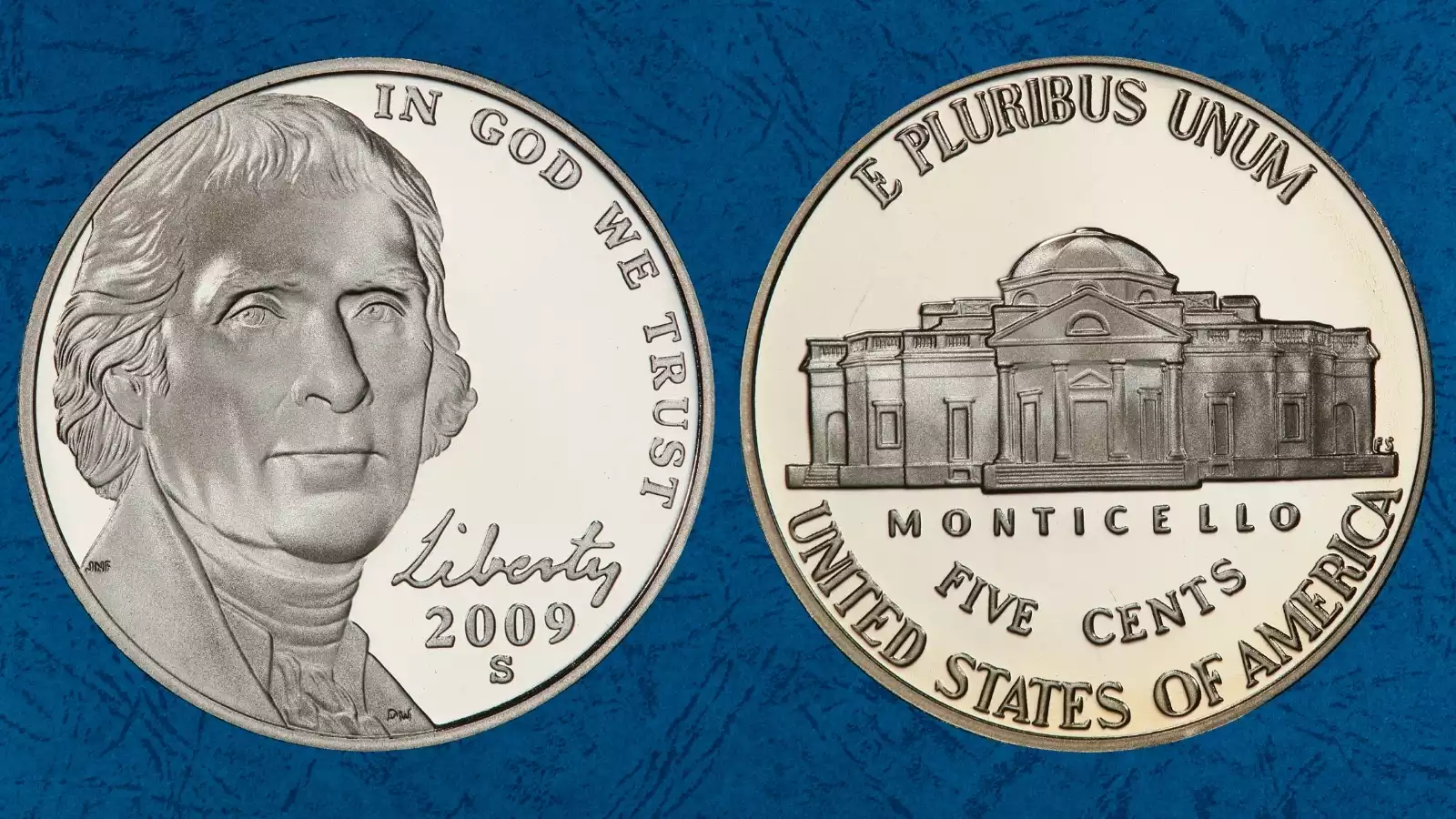
A 2009-P Jefferson Nickel reached $519 in MS69 at a PCGS-recorded eBay auction in June 2022 — yet circulated examples are still worth just five cents. The difference? The Great Recession slashed mintages to just 39.8 million at Philadelphia and 46.8 million at Denver — the lowest since 1951. Add a Full Steps designation and your coin could be worth dramatically more than you think.
★★★★★ Rated 4.8 / 5 by 1,347 collectors · Updated with 2026 auction data
Check My 2009 Nickel Value →Select your coin's mint mark, condition, and any errors to get an instant estimated value range based on real auction data.
Not sure what mint mark or condition your coin has? The 2009 Nickel Coin Value Checker with photo upload is a free third-party tool that can help you identify those details from a photo before you use this calculator.
Describe what you see on your coin and our analyzer will identify relevant varieties and give you tailored guidance.
Our free calculator estimates your 2009 nickel's value in seconds — just pick your mint mark, condition, and any errors.
The Full Steps designation is the single most important factor affecting 2009 nickel value beyond grade. Use this tool to see if your coin might qualify.
Values below are based on recent auction sales and dealer pricing as of 2026. For a thorough step-by-step 2009 Jefferson nickel identification walkthrough with photos for each grade, cross-check with that resource. Highlighted rows indicate the most collector-sought varieties.
| Variety | Worn / Circ. | AU (lightly circ.) | Uncirculated (MS60–64) | Gem (MS65+) |
|---|---|---|---|---|
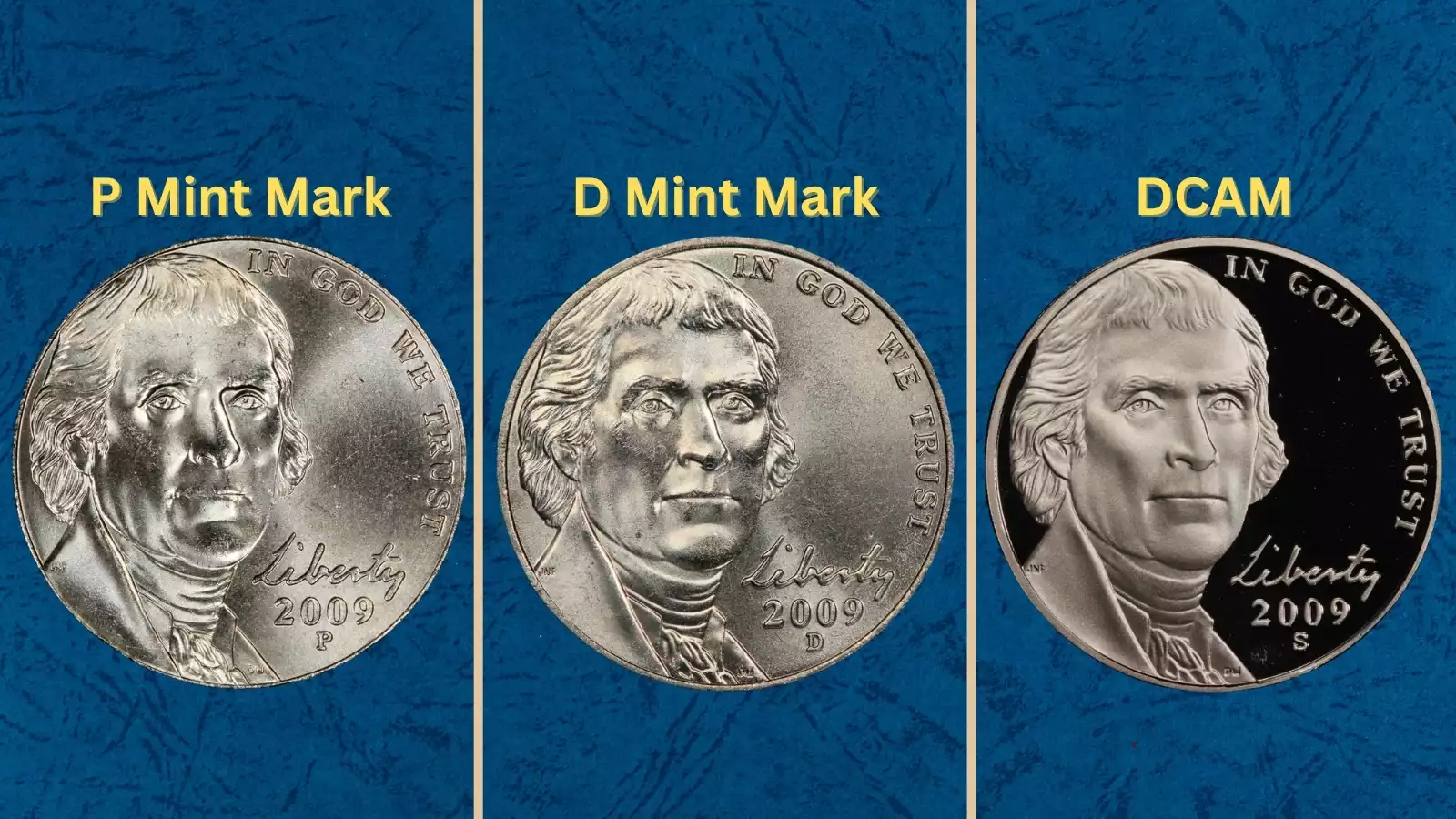
| 2009-P (No FS) | Face value | $1 – $2 | $3 – $11 | $5 – $35 |
| 2009-P Full Steps ⭐ | N/A | N/A | $10 – $40 | $22 – $519+ |
| 2009-D (No FS) | Face value | $1 – $2 | $3 – $11 | $5 – $38 |
| 2009-D Full Steps | N/A | N/A | $10 – $38 | $30 – $295+ |
| 2009-P/D Satin Finish (SP) | N/A | N/A | $3 – $15 | $55 – $195+ |
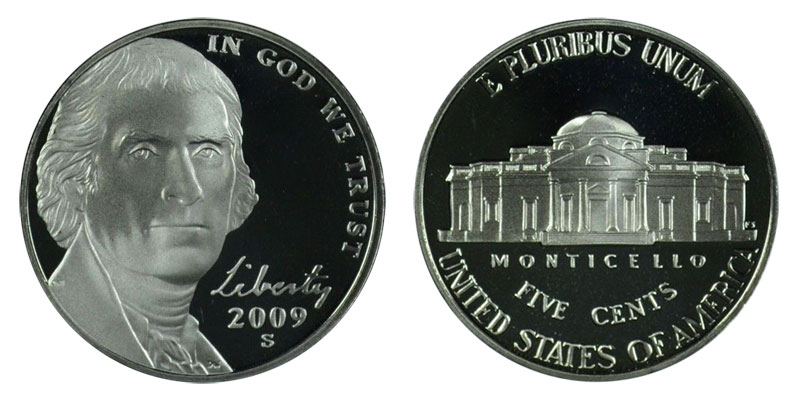
| 2009-S Proof DCAM 🔴 | N/A | N/A | $5 – $15 | $15 – $140+ |
⭐ = Signature variety (Full Steps). 🔴 = Proof issue. Values are estimates; certified examples may exceed ranges shown. N/A = designation does not apply to circulated specimens.
📱 CoinHix lets you snap a photo of your 2009 nickel and instantly estimate its grade and value tier while you're at a coin show or searching through rolls — a coin identifier and value app.
Jump to any section:
Despite its low mintage, the 2009 Jefferson Nickel produced a well-documented range of mint errors. These errors occurred during die preparation, planchet production, and the striking process at both the Philadelphia and Denver Mints. The cards below cover the five most significant error categories, ranked by collector demand and verified auction performance. Use the images and descriptions to compare your coin against known examples.
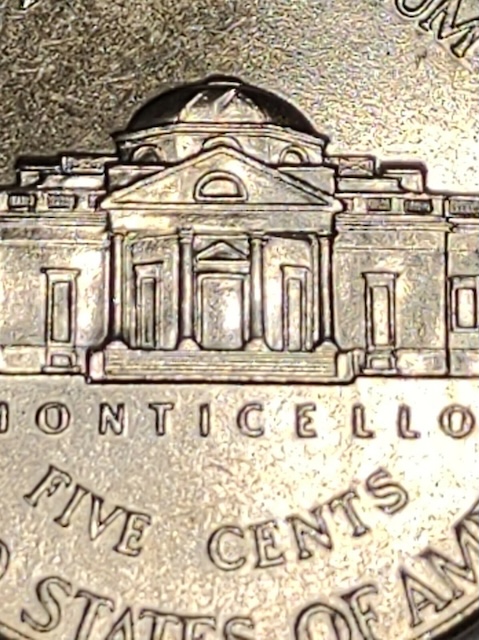
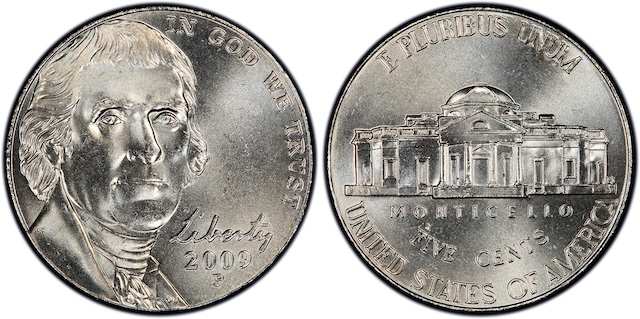
The Full Steps designation is not a mint error — it is a strike quality classification awarded by PCGS and NGC when at least five of Monticello's six horizontal staircase lines are completely visible and uninterrupted. On 2009 circulation strikes, this is genuinely difficult to achieve because the Monticello steps are located in one of the deepest recesses of the reverse die.
To qualify, all visible step lines must run the full horizontal width of Monticello's base without any nick, weak area, or merging. PCGS awards one "FS" designation covering five or more steps, while NGC separately certifies "5FS" and the rarer "6FS." Under a 10× loupe, the lines should be crisp and distinctly separated — not blurred together.
Most 2009 Philadelphia and Denver circulation strikes show partial or no steps due to insufficient striking pressure and die fill at this deep cavity. This scarcity drives dramatic premiums: an MS65 without FS is worth around $5–$10, while an MS65 Full Steps brings $22–$60. The top example — a PCGS MS69 — sold for $519 in June 2022 on a PCGS-recorded eBay sale.
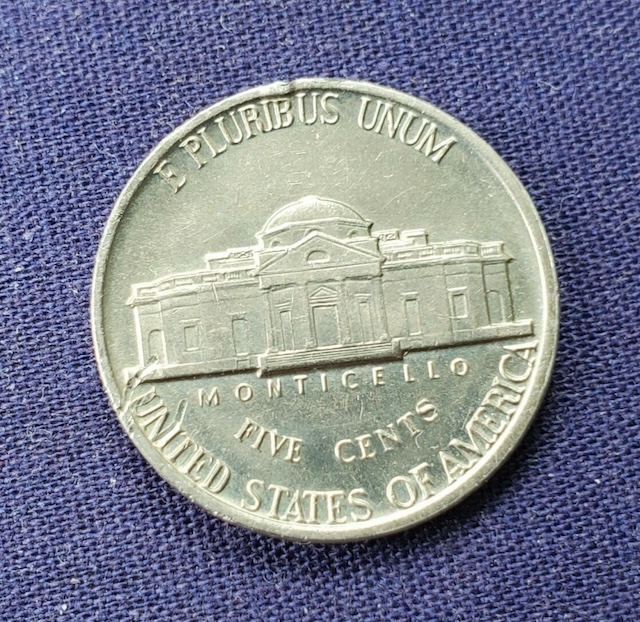
An off-center strike occurs when a planchet is not properly seated within the collar die before the press strikes. The result is a coin whose design is shifted to one side, leaving a blank crescent of exposed planchet metal on the opposite edge. The severity of the off-center is measured as a percentage of the design's displacement.
On 2009 nickels, minor off-center strikes of 5–10% displacement bring $20–$50 in circulated grades. Moderate examples of 15–25% off-center with a fully readable date command $75–$200 in uncirculated condition. The most dramatic specimens showing 40–50% displacement while still retaining a complete, readable date can exceed $500. A 10% off-center 2009-P sold for approximately $600 in a 2020 eBay sale.
The date must be fully visible for maximum value — a dramatic off-center strike with a clipped or missing date is significantly less desirable to collectors. Strike quality and planchet condition also factor heavily: an uncirculated off-center with no post-mint damage commands a substantial premium over a worn example.
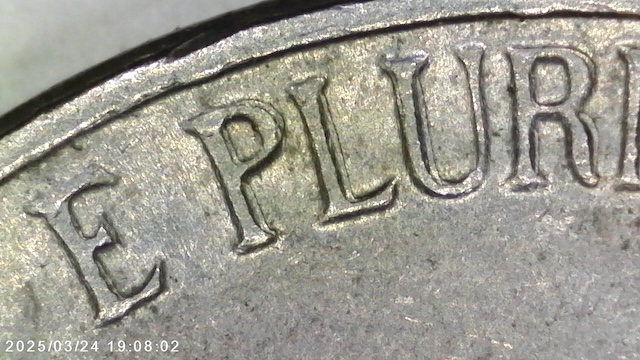
A doubled die error is created during the hub-to-die transfer process at the mint, when a working die receives multiple impressions from the hub that are not perfectly aligned. The result is a permanent doubling in the die itself — meaning every coin struck from that die carries the doubling. This is distinct from machine doubling, which is a post-strike mechanical issue with far less collector value.
On 2009 Jefferson Nickels, doubled die obverse (DDO) varieties show doubling on the word LIBERTY, the date "2009," or Jefferson's portrait details such as the eyebrow or hairline. Doubled die reverse (DDR) examples may show doubling on "MONTICELLO" lettering or on the building's architectural lines. The doubling appears as a distinct "shelf" or secondary image offset from the primary design element.
Minor hub doubling brings $20–$50 over face value. More dramatic examples with strong, widely-spread doubling visible to the naked eye can command $100–$200 or more depending on the specific die state, grade, and eye appeal. Certified DDO or DDR examples with clear separation are the most marketable.
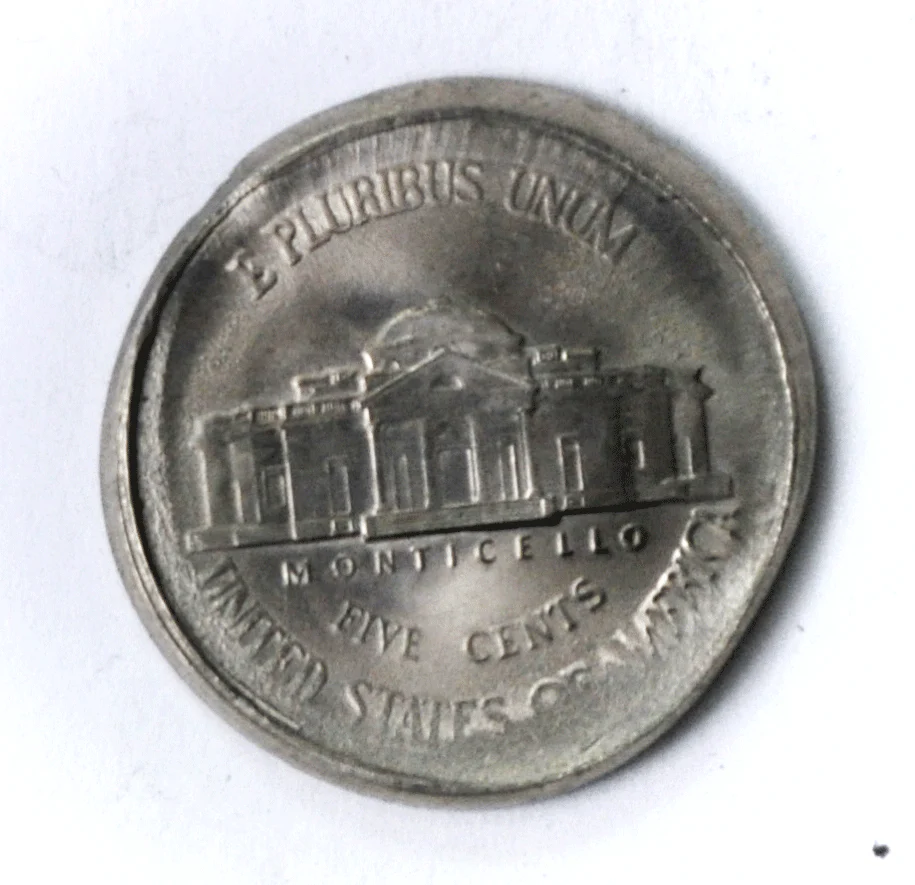
A broadstrike error occurs when a planchet is struck by the dies without the collar die in place to contain and shape the expanding metal. Without the collar, the metal flows outward in all directions, producing a coin that is wider and thinner than normal. The edge, which normally receives no reeding on a nickel, shows an irregular spreading pattern rather than the standard smooth, controlled rim.
Broadstruck 2009 nickels are immediately distinctive: they appear noticeably larger than a standard nickel when placed side by side, with a thinner cross-section and an irregular, spreading rim. The design elements may appear slightly spread or distorted as a result of the uncontrolled metal flow. The coin's planchet itself is genuine — it is the strike, not the blank, that is abnormal.
This is one of the most dramatic and highly collected error types for the 2009 issue. A broadstruck 2009-D Jefferson Nickel sold for $1,040 at auction — the highest documented error sale for this date. Even modest broadstrike examples with full design and no post-mint damage command $50–$200. The rarity of the error on an already low-mintage date amplifies collector demand significantly.
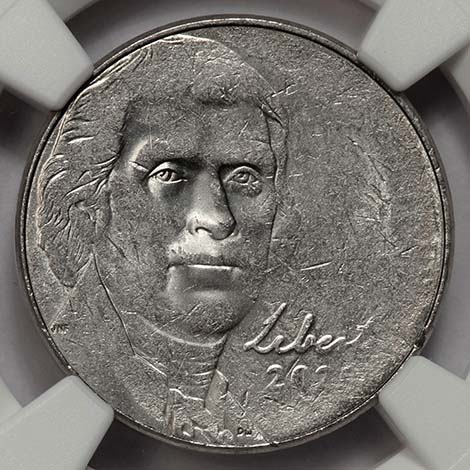
A struck-through grease error occurs when die lubricant, accumulated metal dust, or grease becomes trapped in the recesses of a die face. When the die strikes the planchet, the grease acts as a barrier preventing the metal from fully filling those areas, resulting in weak, soft, or completely missing design elements on the finished coin. The error is produced at the moment of striking and cannot be replicated after the fact.
On 2009 nickels, the most commonly affected areas are the letters of LIBERTY, the date numerals, Jefferson's portrait details, and the Monticello steps on the reverse. Minor affected strikes — where only a small area of lettering is weak — sell for $5–$15. More dramatic examples with noticeable weakness across a major design element bring $40–$63 or more. Extreme cases where multiple major design elements are nearly or completely obliterated can reach $100–$630.
A 2009 grease strike-through sold for $630 in a 2021 auction, per CoinValueChecker records, representing the upper end of the value range for this type. The appeal of grease errors lies in their visual impact: a coin that looks almost blank where detailed design should appear is an immediately striking conversation piece. For collectors, the size and position of the grease patch — particularly if it affects the date or a major portrait element — drives most of the premium.
Use the free calculator to get an instant estimate based on your coin's mint mark, condition, and any error types you've identified.
The 2009 Jefferson Nickel had the lowest combined circulation mintage since 1951, driven by the Great Recession. The U.S. Mint halted production of new nickels and dimes in April 2009, creating an 87.6% year-over-year reduction compared to 2008's output of over 600 million nickels. These low mintage figures are confirmed by the U.S. Mint's official production reports and multiple numismatic sources including PCGS and CoinNews.
| Variety | Mint | Mintage | Finish | Notes |
|---|---|---|---|---|
| 2009-P | Philadelphia | 39,840,000 | Business Strike | Lowest P-mint nickel since 1959; production halted April 2009 |
| 2009-D | Denver | 46,800,000 | Business Strike | Also among lowest D-mint nickels in decades; Denver coins appeared in circulation in early 2010 |
| 2009-P Satin | Philadelphia | 784,614 | Satin (Special Strike) | Sold only in 2009 Uncirculated Mint Sets; matte-like surface, separate series designation |
| 2009-D Satin | Denver | 784,614 | Satin (Special Strike) | Sold only in 2009 Uncirculated Mint Sets; few examples found in SP69 quality |
| 2009-S Proof | San Francisco | 2,179,867 | Proof (DCAM) | Sold in annual proof sets only; Deep Cameo finish; not evaluated for Full Steps |
| Total (all varieties) | ~90,389,095 | — | Compare to 629+ million total in 2008 | |
Jefferson's cheekbone and high-relief hair above the ear show visible flatness or smoothing. Monticello's architectural details are soft and indistinct. Steps are completely flat. Worth face value only — five cents. Date and lettering still fully readable.
Slight wear visible only on the highest points — Jefferson's cheekbone and the top of his hair. Most luster still present, coin may appear nearly uncirculated at first glance. Brings $1–$2. Steps may show 3–4 partial lines but rarely qualify for Full Steps.
No wear whatsoever on any design element. Full original mint luster present, though bag marks, contact marks, or weak strike areas visible under magnification. Value $3–$11 without Full Steps. An MS60–64 coin with Full Steps jumps to $10–$40 depending on strike quality and eye appeal.
Above-average strike with minimal marks. MS65 with no Full Steps: $5–$35. MS65 with Full Steps: $22–$60. MS66 Full Steps has sold for $80–$270. The ultra-rare MS69 level reached $519. Gem coins must be certified by PCGS or NGC to realize top auction prices.
🔎 CoinHix can cross-reference your coin description against graded examples in its database, helping you match your 2009 nickel's condition to certified population data before you decide on submission — a coin identifier and value app.
The right venue depends heavily on your coin's grade, whether it's certified, and how urgently you need to sell. Here are your four best options:
The top choice for certified MS65+ Full Steps examples or dramatic error coins. Heritage routinely handles high-grade Jefferson nickels and attracts serious registry collectors. Best suited for coins worth $100 or more — their buyer's premium reduces net return on lower-value items. Submit at least 6–8 weeks before your target auction date.
The largest active marketplace for 2009 nickels at all price levels. Check recently sold prices for 2009-D Jefferson nickels in MS-FS grade to price your coin competitively. Use "Buy It Now" with Best Offer for raw coins under $50; use auction format for certified pieces. Always include sharp photos of both sides and the edge.
Ideal for quick, same-day cash sales of circulated examples or lower-grade uncirculated coins. Expect 50–70% of retail value — dealers need a margin to resell. Bring comparable eBay sold listings to negotiate from a position of knowledge. Best for bulk lots of circulated 2009 nickels or for getting a quick opinion on condition before deciding where to sell.
The r/Coins and r/CoinSales communities offer direct peer-to-peer sales at fair market prices with zero fees. Good for mid-tier coins ($20–$150) where auction house fees would eat into profits. Post clear photos with a description including grade, mint mark, and any certification. Payment via PayPal Goods & Services protects both parties.
Use our free calculator — just pick your mint mark, condition, and any errors. Instant results, no signup required.
Check My Coin's Value Now →